


Many patients hear the word “laser” and expect a treatment with no pain, no injection and no recovery time. Laser dentistry can make some procedures more comfortable, but it is not a magic fix for every dental problem. Here is what it does, where it helps and how to know if it is right for you.
What is laser dentistry?
Laser dentistry uses a focused beam of light energy to cut, shape or treat tissue in the mouth. Dentists use it mainly on the gums and other soft tissue, and in some cases on teeth.
A laser is one more tool in the dentist’s kit. It works alongside the drill, scalpel and other instruments, not in place of them. Your dentist decides which tool suits your treatment after checking your teeth and gums.
Types of dental lasers
Dental lasers fall into two main groups, based on the tissue they work on:
- Soft tissue lasers: used on the gums, cheeks, tongue and other soft parts of the mouth. Diode lasers are the most common type. They help with gum treatment, gum reshaping, tongue-tie release and sensitivity.
- Hard tissue lasers: used on teeth and bone. Erbium lasers fall in this group. They can remove small areas of tooth decay and prepare a tooth for a tooth-coloured filling in selected cases.
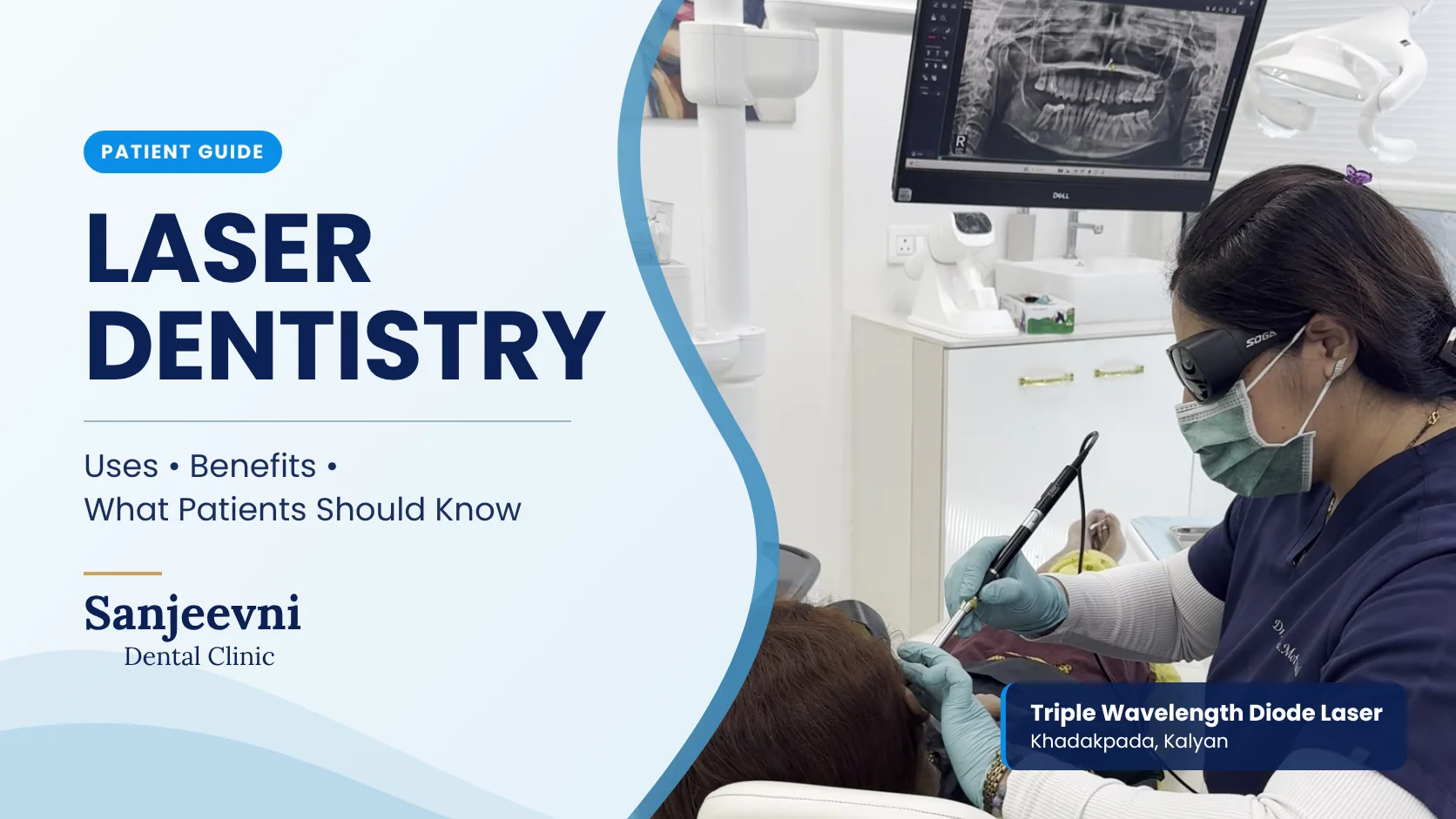
For laser dental treatment at Sanjeevni Dental Clinic, we use a triple wavelength soft tissue diode laser, as most laser procedures involve the gums. Your dentist will tell you which type suits your treatment.
What can a dental laser be used for?
Common uses of laser dental treatment include:
- Gum treatment: removing infected gum tissue and bacteria around the roots in gum disease (gingivectomy)
- Gum reshaping: correcting an uneven gum line (gingivoplasty) or a “gummy” smile, often as part of smile designing
- Tongue-tie release: removing the tight tissue under the tongue (frenectomy)
- Tooth sensitivity: sealing the tiny channels in the tooth that cause sensitivity to cold and sweet
- Laser-assisted teeth whitening: activating the whitening gel to speed up teeth whitening results
- TMJ disorders: relieving clicking, popping and limited mouth opening, and reducing inflammation of the temporomandibular (jaw) joint
- Healing after surgery: speeding up healing of surgical sites, especially in more complex cases
Not every patient with these problems needs a laser. For many treatments, conventional methods work just as well.
Benefits of laser dentistry
When it is used for the right procedure, laser treatment can offer:
- Precision: the laser targets the problem area and leaves healthy tissue largely untouched
- Less bleeding: the beam helps seal small blood vessels during gum procedures
- More comfort: some patients feel less pain and swelling during and after treatment
- Faster healing: minor gum procedures often heal quickly and may not need stitches
- Less anxiety: patients who fear the sound of the drill often find laser treatment easier
What laser dentistry cannot do
It is important to have the right expectations:
- Laser treatment is not always painless. You may still need local anaesthesia.
- Lasers cannot replace conventional treatment for every procedure, such as large fillings or dental crowns.
- Results and recovery differ from patient to patient.
Laser vs traditional treatment
Here is how laser treatment generally compares with traditional methods for minor gum procedures:
| Factor | Laser treatment | Traditional treatment |
|---|---|---|
| Cutting tool | Focused light energy | Scalpel or drill |
| Bleeding | Usually less | More likely |
| Stitches | Often not needed | Often needed |
| Swelling and discomfort | Usually less | Can be more |
| Healing time | Often faster | Can take longer |
| Anaesthesia | Sometimes still needed | Usually needed |
The best choice depends on your diagnosis. For some treatments, the traditional method is still the better option.
What to expect during treatment
Your dentist first examines your teeth, gums and temporomandibular joint (as the case may require) and explains whether a laser suits your case. On the day of treatment, you and the dental team wear protective glasses. Most minor laser procedures take anywhere from a few minutes to less than an hour, thanks to the laser’s speed and precision, and you can usually return to normal activities the same day. Your dentist will share aftercare instructions for the procedure you had.
Aftercare tips after laser gum treatment
Good aftercare helps the treated area heal well. Common advice after a laser gum procedure includes:
- Eat soft, lukewarm food for the first day or two. Avoid very hot, spicy or crunchy food.
- Brush gently with a soft toothbrush and avoid scrubbing the treated area.
- Rinse with warm salt water or the mouthwash your dentist recommends.
- Avoid smoking and alcohol while the gums heal.
- Take any medicine exactly as your dentist prescribes.
- Call the clinic if you notice heavy bleeding, increasing pain or swelling. Read more on emergency dental care in Kalyan.
Follow the instructions your dentist gives you, as aftercare can differ by procedure.
Is laser dentistry right for you?
The right treatment depends on your symptoms, your oral health and the procedure you need. A dental check-up is the only way to know whether a laser is the better option or whether another method will give you a better result.
At Sanjeevni Dental Clinic in Khadakpada, our dentists will examine your teeth and gums and explain your options clearly before any treatment. Learn more about laser dentistry in Kalyan at our clinic.
Book a Consultation in Kalyan
Have a gum problem, sensitive teeth or a dental concern you have been putting off? Speak to our team and understand your treatment options at Sanjeevni Dental Clinic, 9 Square, Sai Chowk, 405, Khadakpada, Kalyan, Maharashtra 421301.
Frequently Asked Questions
Most patients feel less discomfort than with traditional methods, especially in gum procedures. Some treatments still need local anaesthesia, and your dentist will tell you in advance.
Yes, lasers are often used to remove infected gum tissue and bacteria. The exact treatment depends on how advanced the gum disease is.
Yes, when a trained dentist performs it. Both the patient and the dental team wear eye protection during the procedure.
No. A laser is an extra tool for specific procedures. Many treatments still need conventional instruments.
Book a check-up. Your dentist will examine your teeth and gums before recommending laser treatment or another option.
Minor laser gum procedures usually heal in less than a week. Healing time may vary according to the procedure and your medical condition, and following aftercare advice closely helps.
Laser treatment can cost slightly more because of the equipment involved. The final cost depends on the procedure, so ask the clinic for an estimate after your check-up. See our guide to laser dentistry cost in Kalyan for typical price ranges.
References
- Cleveland Clinic: Laser Dentistry
- Indian Dental Association: Special Dental Procedures